

Spot Firefighting Drones
Spot Firefighting Drones
Spot Firefighting Drones
An AI-powered wildfire protection system that detects, prevents, and suppresses fires in real time for residential properties.
An AI-powered wildfire protection system that detects, prevents, and suppresses fires in real time for residential properties.

Skills
Project Strategy, UX Design, Project Management, Branding
Role
Project Manager and Lead Designer
Timeline
2025 (1 Semester)
Role
Role
Project Manager and Lead Designer
Project Manager and Lead Designer
Skills
Skills
Project Strategy, UX Design, Project Management, Branding
Project Strategy, UX Design, Project Management, Branding
Timeline
Timeline
2025 (1 Semester)
2025 (1 Semester)
Project Brief
Project Brief
As part of the Case Studies in Innovation course, the goal of this project was to identify a real market need and evaluate whether a product solution should be brought to life. We chose to explore residential wildfire protection due to its growing relevance following recent Los Angeles wildfires.
To assess viability, we conducted market and customer research, built a functional landing page, tested interest through organic community-driven content and paid advertising, and synthesized our findings into an investor-facing pitch deck.
As part of the Case Studies in Innovation course, the goal of this project was to identify a real market need and evaluate whether a product solution should be brought to life. We chose to explore residential wildfire protection due to its growing relevance following recent Los Angeles wildfires.
To assess viability, we conducted market and customer research, built a functional landing page, tested interest through organic community-driven content and paid advertising, and synthesized our findings into an investor-facing pitch deck.

Problem
Problem
Residential wildfires are increasing in frequency, scale, and cost, yet most protection systems stop at detection and alerts rather than taking action. Homeowners in high-risk areas are left dependent on delayed emergency response, with few proactive tools designed to intervene during the earliest and most preventable stages of a fire. As wildfire risk continues to rise, the gap between awareness and protection has become a critical problem for residential communities.
Residential wildfires are increasing in frequency, scale, and cost, yet most protection systems stop at detection and alerts rather than taking action. Homeowners in high-risk areas are left dependent on delayed emergency response, with few proactive tools designed to intervene during the earliest and most preventable stages of a fire. As wildfire risk continues to rise, the gap between awareness and protection has become a critical problem for residential communities.

The Solution
The Solution
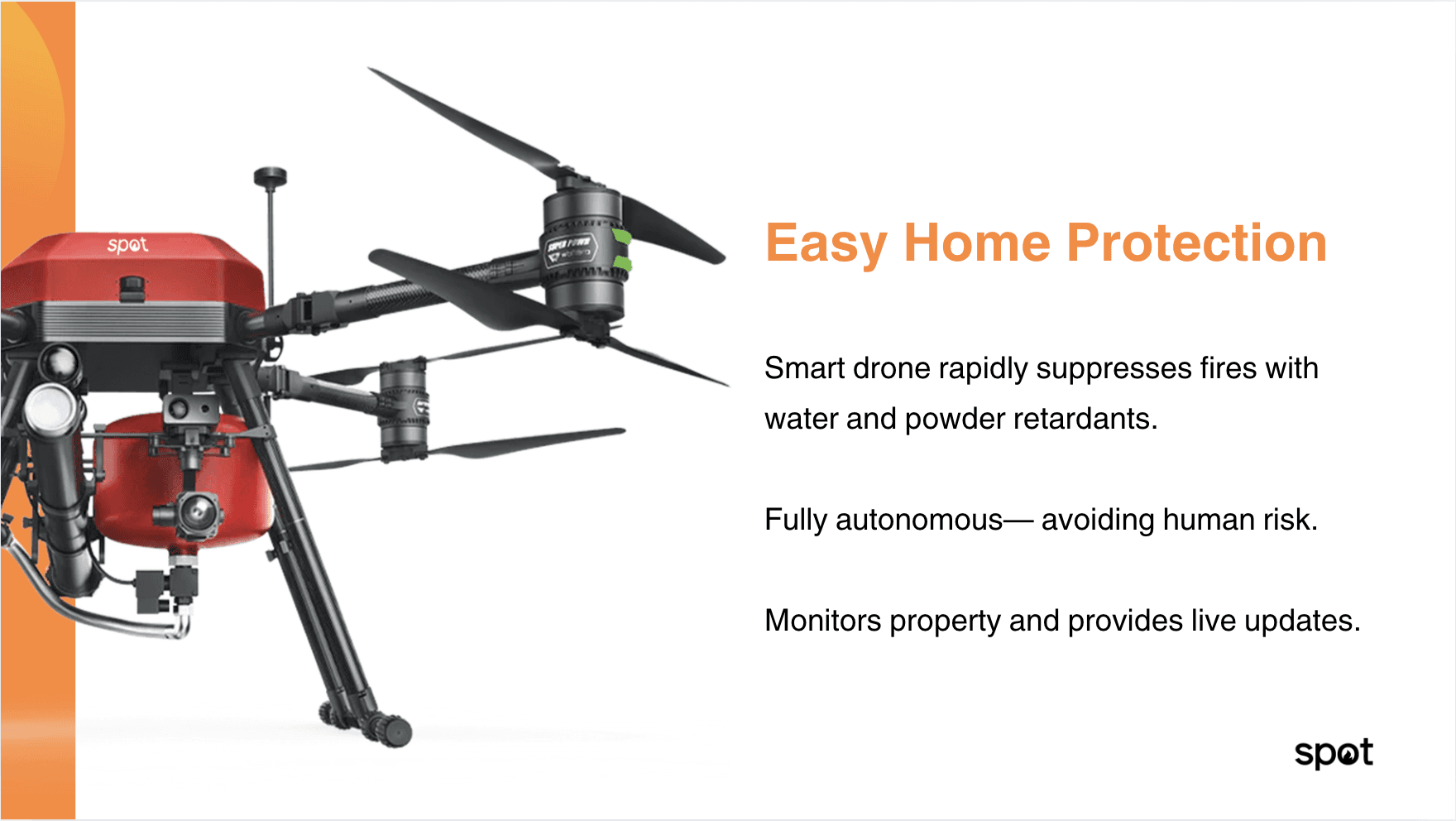
SPOT is a residential wildfire protection system that uses autonomous drones and environmental sensors to detect and respond to fire threats in real time. When a risk is identified, drones deploy from an on-site docking station to assess the area and initiate targeted fire suppression, reducing reliance on delayed emergency response or manual intervention.
SPOT is a residential wildfire protection system that uses autonomous drones and environmental sensors to detect and respond to fire threats in real time. When a risk is identified, drones deploy from an on-site docking station to assess the area and initiate targeted fire suppression, reducing reliance on delayed emergency response or manual intervention.
Landing Page as a Validation Tool
Landing Page as a Validation Tool
To validate whether residential wildfire protection was a problem users genuinely cared about, we designed and launched a functional, investor-facing landing page before building the system itself. Rather than testing the technology, the goal was to measure market interest, messaging resonance, and willingness to take action.
The page framed the wildfire risk, introduced SPOT as a proactive solution, and guided users through key features with a clear call to action to learn more and join the waitlist. We used engagement signals—such as time on page, scroll depth, and CTA clicks—to assess whether users moved beyond an initial impression and demonstrated sustained interest.
To validate whether residential wildfire protection was a problem users genuinely cared about, we designed and launched a functional, investor-facing landing page before building the system itself. Rather than testing the technology, the goal was to measure market interest, messaging resonance, and willingness to take action.
The page framed the wildfire risk, introduced SPOT as a proactive solution, and guided users through key features with a clear call to action to learn more and join the waitlist. We used engagement signals—such as time on page, scroll depth, and CTA clicks—to assess whether users moved beyond an initial impression and demonstrated sustained interest.
To validate whether residential wildfire protection was a problem users genuinely cared about, we designed and launched a functional, investor-facing landing page before building the system itself. Rather than testing the technology, the goal was to measure market interest, messaging resonance, and willingness to take action.
The page framed the wildfire risk, introduced SPOT as a proactive solution, and guided users through key features with a clear call to action to learn more and join the waitlist. We used engagement signals—such as time on page, scroll depth, and CTA clicks—to assess whether users moved beyond an initial impression and demonstrated sustained interest.


Organic & Paid Ad Validation
Organic & Paid Ad Validation
To drive traffic and test demand, we combined organic community-driven content with targeted paid social ads, all directing users to the landing page.
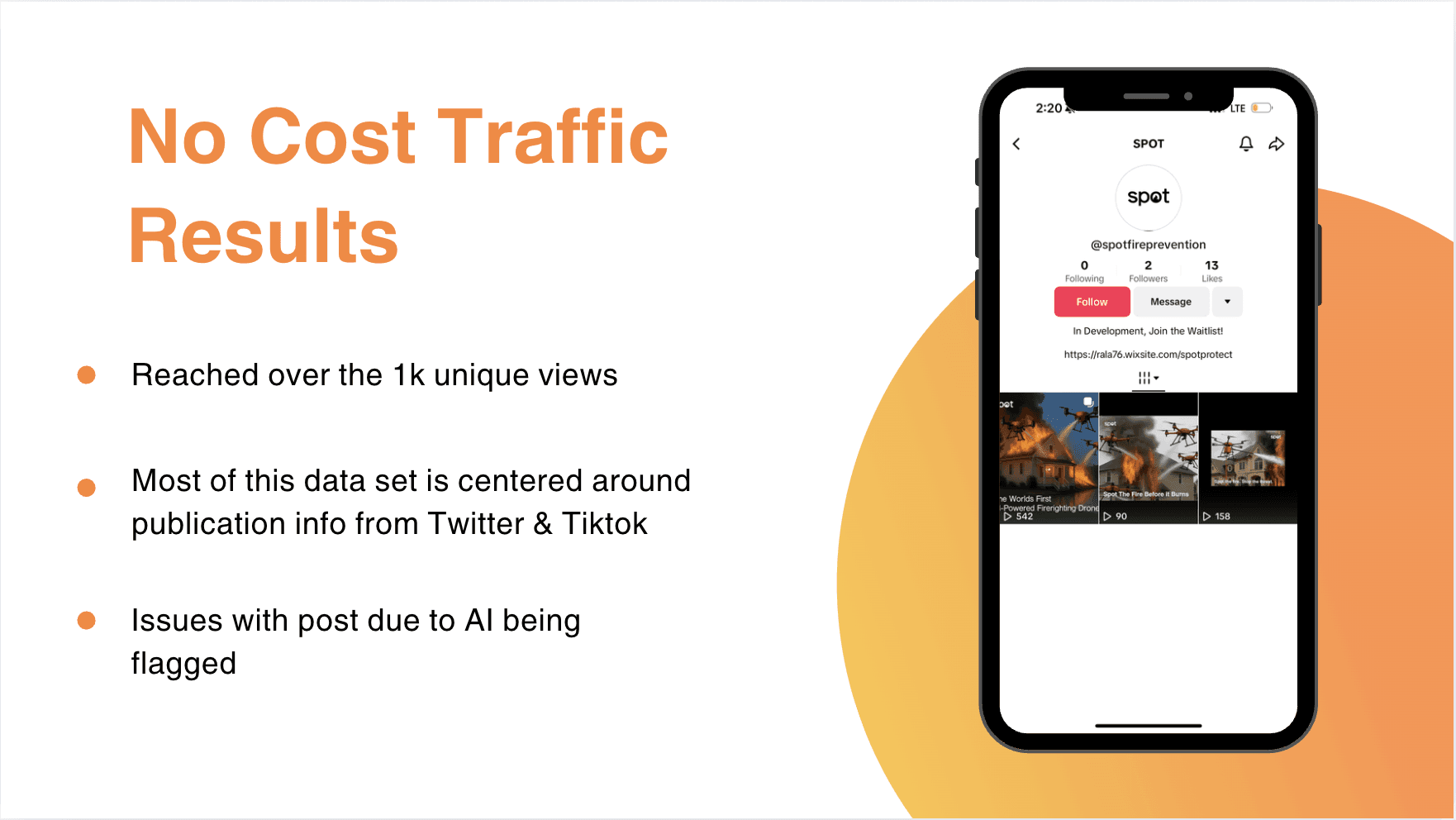
Organic posts on platforms like TikTok and Twitter focused on wildfire awareness and homeowner risk rather than directly promoting SPOT, generating 1,000+ unique views with no marketing budget. We then ran paid ads on Facebook and Instagram targeting homeowners in wildfire-prone regions to test whether users would intentionally engage with the CTA.
Metrics such as click-through rate, landing page engagement, and cost per lead provided quantitative validation.
To drive traffic and test demand, we combined organic community-driven content with targeted paid social ads, all directing users to the landing page.
Organic posts on platforms like TikTok and Twitter focused on wildfire awareness and homeowner risk rather than directly promoting SPOT, generating 1,000+ unique views with no marketing budget. We then ran paid ads on Facebook and Instagram targeting homeowners in wildfire-prone regions to test whether users would intentionally engage with the CTA.
Metrics such as click-through rate, landing page engagement, and cost per lead provided quantitative validation.

Evaluating Validation Results
Evaluating Validation Results
To understand whether SPOT addressed a real and urgent market need, we analyzed engagement data collected from our landing page and ad experiments across both organic and paid channels.
Strong CTR confirmed demand and urgency around residential wildfire protection
Users were willing to explore the concept but hesitant to fully convert
Validation signaled clear market interest while highlighting gaps in trust and readiness
These insights informed our decision-making around whether SPOT should advance beyond validation
To understand whether SPOT addressed a real and urgent market need, we analyzed engagement data collected from our landing page and ad experiments across both organic and paid channels.
Strong CTR confirmed demand and urgency around residential wildfire protection
Users were willing to explore the concept but hesitant to fully convert
Validation signaled clear market interest while highlighting gaps in trust and readiness
These insights informed our decision-making around whether SPOT should advance beyond validation

Reflection
Reflection
This project showed me how essential early validation is before investing significant time and resources into building a product. Rather than assuming demand, we used low-cost tools like landing pages and ad testing to determine whether the market actually cared. Through zero- and low-cost traffic, we were able to test community interest and observe how users engaged with our messaging, revealing levels of urgency, curiosity, and willingness to explore the idea.
The data also helped us evaluate our own viability as a team. While strong click-through rates confirmed interest in residential wildfire protection, low conversion highlighted gaps in trust, readiness, and feasibility. Validation ultimately showed that although the problem is real and the concept has potential, moving forward would require increased ad spend, a narrow high-income early adopter market, and deeper technical expertise. This experience reinforced that passion alone is not enough; founder-market fit and data-driven decision-making are just as critical.
This project showed me how essential early validation is before investing significant time and resources into building a product. Rather than assuming demand, we used low-cost tools like landing pages and ad testing to determine whether the market actually cared. Through zero- and low-cost traffic, we were able to test community interest and observe how users engaged with our messaging, revealing levels of urgency, curiosity, and willingness to explore the idea.
The data also helped us evaluate our own viability as a team. While strong click-through rates confirmed interest in residential wildfire protection, low conversion highlighted gaps in trust, readiness, and feasibility. Validation ultimately showed that although the problem is real and the concept has potential, moving forward would require increased ad spend, a narrow high-income early adopter market, and deeper technical expertise. This experience reinforced that passion alone is not enough; founder-market fit and data-driven decision-making are just as critical.